
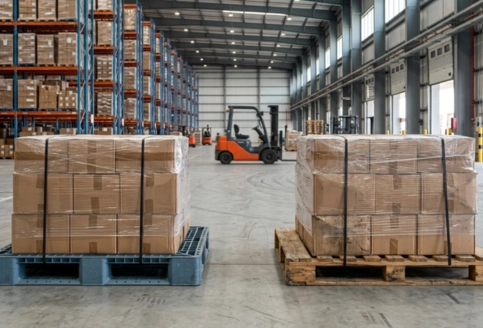
UAE logistics companies are under growing pressure to reduce waste, fuel use, and carbon emissions without slowing down daily operations. Choosing the right pallet can make a difference, especially when shipments move through warehouses, cold chains, and regional distribution networks.
Wood pallets usually have a lower carbon footprint when used for only one or a few trips. Plastic pallets have higher manufacturing emissions, but their longer service life can spread those emissions across many trips.
In the UAE, plastic pallets can become the better option for closed-loop logistics because they handle repeated use, washing, and moisture better. The carbon footprint comparison of plastic pallets vs. wood pallets therefore depends on how often each pallet is used, transported, repaired, and recycled.
Manufacturing is where the biggest difference appears between the two pallet types. Wooden pallets generally need less processing energy because timber is cut, dried, and assembled into a pallet.
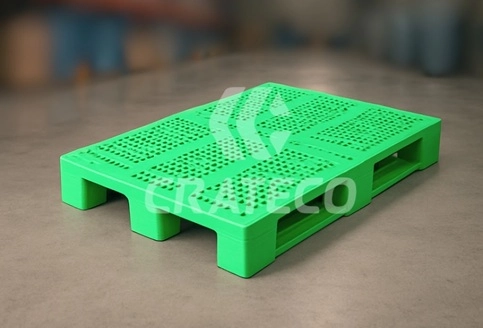
Plastic pallets are commonly made from HDPE or PP, which require more energy for material production and injection molding.
Available lifecycle studies show wooden pallets can have an initial footprint of roughly 4 to 26 kg CO₂-eq, while virgin plastic pallets can range from about 38 to 166 kg CO₂-eq. These figures vary by material source, pallet design, manufacturing process, and study method.
Wood pallets benefit from relatively simple manufacturing. Timber is cut into boards, dried, treated where required, and assembled using nails or other fasteners.
The wood itself also stores biogenic carbon during its growth, although the full climate benefit depends on forestry practices and what happens at the end of its life.
Energy use for wood processing is usually much lower than for producing virgin plastic. This gives wood a strong advantage when a pallet is used for a limited number of trips and is not returned through a controlled supply chain.
Plastic pallets normally use polymers such as high-density polyethylene or polypropylene. Producing these materials and forming them through injection molding requires considerably more energy than basic wood pallet assembly.
Virgin resin also comes from fossil-based feedstocks, which increases its embodied carbon. Some estimates place plastic manufacturing energy at around 104 kWh/m² compared with about 0.69 kWh/m² for wood processing, although actual figures depend on the product and production method.
The higher starting footprint means plastic needs repeated use to make its lifecycle performance more competitive. So, this is why more companies are switching to plastic pallets for shipping.
A direct comparison needs more than manufacturing emissions. The number of trips, pallet weight, repair rate, cleaning needs, transport distance, and end-of-life treatment can all change the result.
Wood may have a clear advantage during a single trip, but that advantage can shrink when frequent replacement is needed. Plastic usually carries a larger initial carbon burden but can spread it across dozens of trips.
The table below shows the main factors that UAE logistics managers should consider when selecting pallets for industrial packaging and material handling.
| Factor | Wood Pallets | Plastic Pallets | UAE Logistics Impact |
|---|---|---|---|
| Initial production footprint | Approx. 4 to 26 kg CO₂-eq | Approx. 38 to 166 kg CO₂-eq | Wood has the lower starting footprint |
| Typical repeated use | Around 5 to 20 trips, depending on design and handling | Around 66 to 100+ trips for durable models | Frequent reuse can improve plastic's lifecycle result |
| Weight | Often 20 to 25 kg | Often 12 to 18 kg | Lower pallet weight can reduce transport energy |
| Moisture resistance | Can absorb water | Non-porous | Plastic suits wet and chilled environments |
| Cleaning | Can be harder to sanitize fully | Easy to wash and sanitize | Useful for food and pharmaceutical supply chains |
| ISPM-15 | Generally required for international wood shipments | Not required for plastic pallets | Plastic avoids heat-treatment requirements |
| Repair | Often repairable | Many models are repaired or replaced by component | Depends on pallet design |
| End of life | Can be reused, recycled, chipped, or used for energy recovery | Can be recycled into secondary plastic | Recycling systems affect final carbon results |
| Best use case | Shorter or open-loop movements | Repeated closed-loop movements | Match pallet type to the logistics cycle |
The UAE climate can change the practical lifespan of a pallet. Summer temperatures can rise above 45°C, while strong sunlight, dry air, and repeated movement between outdoor yards and indoor warehouses place extra stress on materials.
Wood can dry, split, splinter, or lose strength when exposed to harsh conditions and poor storage. Plastic pallets are not immune to heat, but suitable grades and designs can provide more consistent performance in demanding logistics environments.
When a pallet lasts longer, fewer replacement units are needed, which can reduce the emissions linked to manufacturing and delivery.
Pallet weight affects the amount of energy needed to move goods. A typical plastic pallet can weigh around 12 to 18 kg, while some heavy-duty wooden pallets can weigh 20 to 25 kg or more.
The difference becomes more important when thousands of pallets are moved across the UAE or GCC. Lighter units can reduce the total payload weight of trucks and other transport systems.
However, the actual carbon saving depends on vehicle type, distance, load capacity, fuel efficiency, and the total weight of the goods being transported.
Closed-loop logistics can change the carbon result because pallets are collected, inspected, and used again instead of being discarded after one shipment.
This model works well for manufacturers, distributors, retailers, and cold-chain operators that move goods between known locations. Plastic pallets are especially suited to this system because they can be used repeatedly and tracked more easily when standardized sizes are used.
A high initial manufacturing footprint becomes less important when the same pallet completes many rotations. The key is to actually recover and reuse the pallets rather than allowing them to leave the network.
Food, beverage, and pharmaceutical logistics place strong demands on pallet hygiene. Wooden pallets can absorb water and may develop cracks or rough surfaces that make cleaning more difficult.
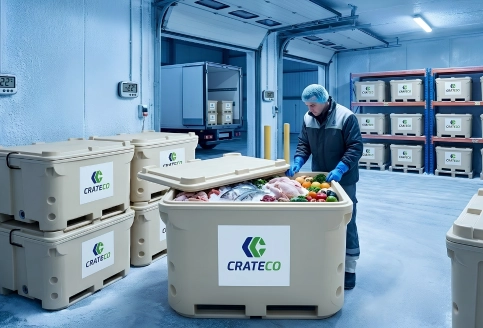
Plastic pallets have a non-porous surface that can be washed and sanitized more easily. This is useful in cold storage, food distribution, and other controlled environments where hygiene is important.
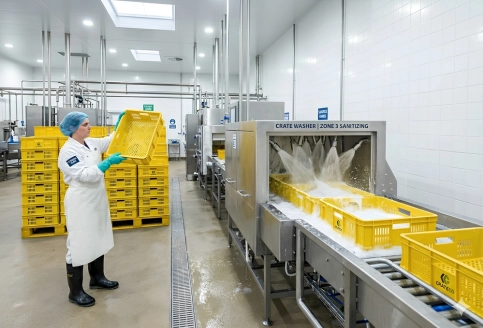
Better cleanability can also reduce the need to replace damaged pallets. However, the environmental benefit depends on the cleaning system. Frequent high-pressure washing uses water, electricity, and cleaning agents, so efficient cleaning practices remain important.
Wood packaging used in international trade may need to meet ISPM-15 rules, which include approved pest-control treatment such as heat treatment. The process adds energy use and creates another step before export.
Plastic pallets do not require the same phytosanitary treatment because they do not carry the pest risks associated with untreated solid wood. This can simplify cross-border logistics for companies moving goods from the UAE to GCC and international markets.
Still, shipping rules can vary by destination and product type, so exporters should confirm current requirements before selecting packaging for a particular trade route.
The final stage of a pallet's life also affects its total environmental impact. Wooden pallets can often be repaired, reused, chipped, or recovered for energy, although damaged units may still enter waste streams.
Plastic pallets can be recycled into secondary polymer products when suitable collection and recycling systems are available. This helps reduce demand for new virgin material. However, plastic should not be treated as automatically sustainable simply because it is recyclable.
The environmental result depends on whether the pallet is collected, reused, and actually sent to a suitable recycling facility instead of being lost to unmanaged waste.
There is no single pallet material that creates the lowest emissions for every logistics model. The best choice depends on trip frequency, recovery rates, shipment type, climate exposure, export rules, and end-of-life planning.
A company sending pallets to customers and rarely getting them back may benefit from wood's lower initial footprint. A company moving products between its own warehouses every week may gain more from durable plastic units.
These alternatives should therefore be selected according to the full logistics cycle rather than production emissions alone.
Wood pallets can be a practical choice when pallets are used for a small number of trips or are unlikely to return to the UAE. Their low manufacturing footprint gives them an advantage when the logistics cycle is short.
They are also widely available and can often be repaired locally. Exporters should account for ISPM-15 treatment when required and consider the added impact of replacement pallets if units are damaged during transport.
For one-way or low-recovery shipments, the lower upfront carbon burden of wood can remain an important advantage.
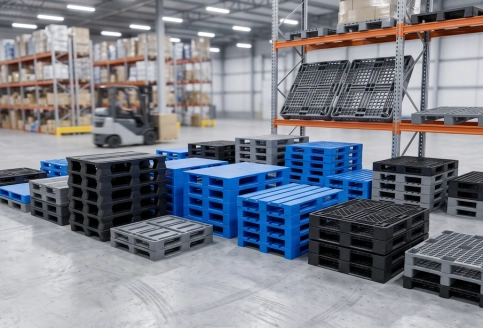
Plastic pallets are better suited to high-frequency systems where the same units return to a central warehouse or distribution network. Their long service life allows the initial manufacturing emissions to be spread over many trips.
Durable plastic models can also handle moisture, regular cleaning, and repeated handling with less risk of splintering. This makes them useful for food, beverage, pharmaceutical, retail, and industrial supply chains.
For UAE companies with strong pallet recovery systems, repeated reuse can make plastic a more efficient long-term choice despite its higher production footprint.
Some UAE businesses may not need to choose only one pallet type. A hybrid system can use plastic pallets for internal movements, cold-chain operations, and regular GCC distribution while using wood for one-way export shipments.
This approach can reduce unnecessary plastic production while keeping durable assets in routes where they deliver the most value. Companies can also track pallet rotations, repair rates, recovery percentages, and disposal volumes.
These metrics provide a clearer view of actual carbon performance than looking only at the material used to manufacture the pallet.
The break-even point depends on the actual design and lifecycle of both pallet types. Some estimates suggest a virgin plastic pallet may need roughly 60 to 80 trips before its carbon impact per trip becomes lower than an equivalent wooden pallet system.
This is not a fixed number for every product. A wooden pallet that completes only a few trips because of damage can move the break-even point much earlier.
Likewise, a plastic pallet that is lost after a small number of trips cannot spread its manufacturing footprint across its expected service life.
Companies should measure actual pallet performance instead of relying only on general industry averages. Useful metrics include the number of trips per pallet, average pallet weight, damage rate, repair rate, return rate, cleaning energy, transport distance, and end-of-life recovery.
These figures can be used in a lifecycle assessment to estimate emissions per trip or per tonne of goods moved. Tracking these numbers also helps identify where pallets are being lost or damaged.
Better asset control can improve both cost efficiency and environmental performance without requiring a complete change in packaging materials.
The carbon footprint comparison between plastic pallets and wood pallets shows that wood usually starts with a clear advantage because it requires less energy to manufacture.
Plastic pallets begin with higher embodied carbon, but their longer lifespan, lower weight, easy cleaning, and strong reuse potential can change the result in UAE logistics. Wood remains suitable for many short or open-loop shipments, while plastic can perform better in high-frequency closed-loop networks.
The most sustainable choice is the pallet that is used efficiently, recovered after each trip, maintained properly, and recycled or reused at the end of its service life.
For businesses looking for durable industrial packaging, Crateco Pack LLC is a leading crate supplier in the UAE, offering plastic pallets, crates, spill pallets, waste bins, and other material-handling solutions for UAE and GCC operations.
Choosing the right reusable packaging can help businesses improve handling efficiency while supporting better long-term resource use.