
Chemical storage regulations in the UAE apply to every facility that handles hazardous liquids, solvents, or flammable substances. Getting this wrong is expensive. Under UAE Law No. 4 of 2025, fines start at AED 1,000 and go up to AED 1,000,000. Repeat violations double the fine. Serious cases lead to license suspension, criminal charges, and voided insurance.
The 2 tools at the center of chemical storage compliance are IBC tanks and spill containment systems. This Crateco guide covers what the regulations require, why IBC tanks are the industry standard, and how to pick the right spill control product.
Crateco is one of the UAE's leading plastic manufacturers and suppliers. The company produces industrial-grade IBC tanks, spill containment pallets, and chemical storage solutions built for UAE conditions. Facilities across Dubai, Abu Dhabi, and Sharjah rely on Crateco for compliant, durable storage equipment.
3 main authorities regulate chemical storage:
| Authority | Jurisdiction | Key Responsibilities |
|---|---|---|
| Dubai Civil Defence (DCD) | Dubai | Enforces the Fire and Life Safety Code of Practice; covers storage design, fire suppression, and secondary containment |
| Dubai Municipality | Dubai | Handles environmental and public health compliance; oversees hazardous waste documentation |
| Free Zone Bodies | TRAKHEES (Jafza, DWC), CICPA (KIZAD, Mussafah) | Apply zone-level rules on top of the federal framework |
The Dubai Civil Defence Code of Practice for the Management of Dangerous Goods requires all storage sites to hold valid trade licenses, approved layouts, current Safety Data Sheets (SDS), and passing inspection records.
Facilities in Abu Dhabi Industrial City, Sharjah Industrial Area, or Ras Al Khaimah free zones follow their own emirate-level civil defence rules. The federal standards are the same. But inspection steps differ by zone.
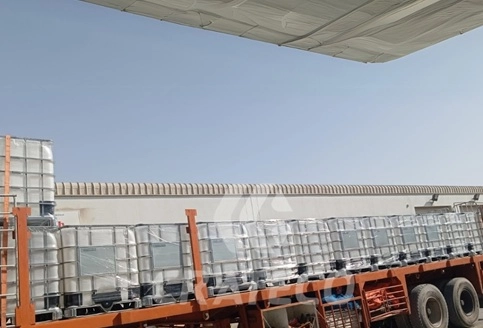
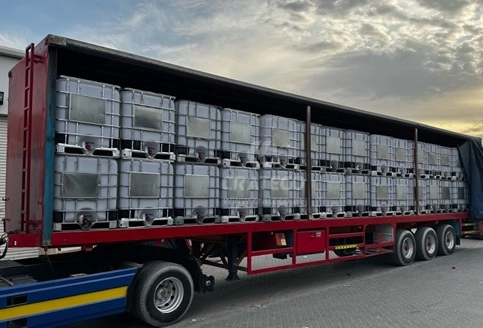
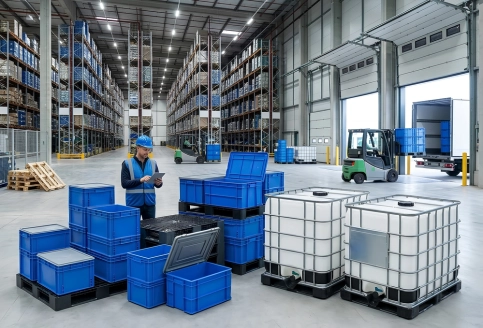
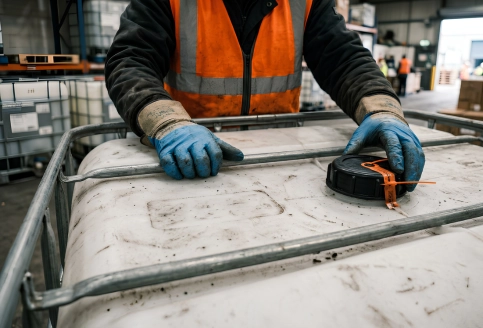
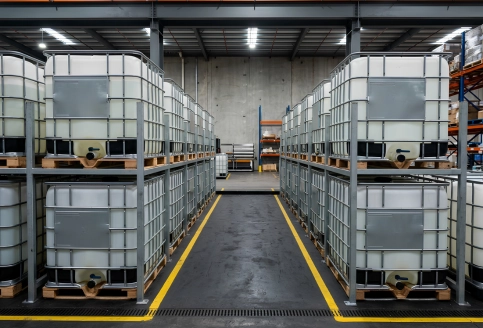
An IBC (Intermediate Bulk Container) tank is a standard industrial container for storing and moving bulk liquids. The most common size is 1,000 litres. It has an HDPE inner bottle inside a steel cage frame. The whole unit sits on a plastic pallet base.
According to SNS Insider market research (2024), the global IBC market was worth USD 9.56 billion in 2023. Rigid HDPE IBCs held 62% of that market. Their strength and wide chemical compatibility drive that share.
IBC tanks replace drum storage across industries for 4 clear reasons:
| Advantage | Detail |
|---|---|
| Space Savings | One 1,000-litre IBC replaces 5 x 200-litre drums |
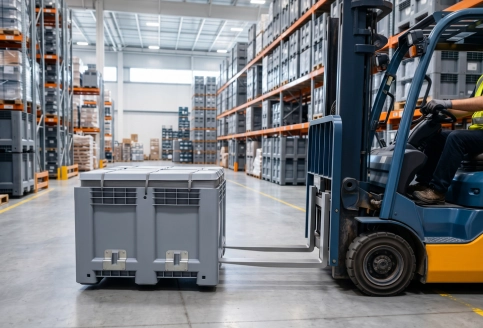
| Forklift Compatibility | The pallet base fits standard warehouse equipment |
| Chemical Range | One container type stores acids, alkalis, solvents, oils, and food-grade liquids |
| Reusability | Certified IBCs are cleaned and reused, cutting single-use container waste |
UAE industries that use IBC tanks include oil and gas (Abu Dhabi, Ruwais), chemical manufacturing (Jebel Ali, Mussafah), agriculture (Al Ain, Fujairah), pharmaceuticals (Dubai Science Park), and food processing (Dubai Industrial City).
Not all IBC tanks meet UAE legal standards. For hazardous material storage, UAE civil defence and free zone regulators accept UN-Approved IBC tanks only.
The UN Recommendations on the Transport of Dangerous Goods (23rd Edition, 2023) set out the tests an IBC must pass to carry a UN mark:
| Test | Requirement |
|---|---|
| Drop Test | Dropped from 0.8 metres at full capacity |
| Stacking Test | Must withstand 1.8 times the weight of identical full containers stacked on top |
| Leakproofness Test | Tested at 30 kPa internal pressure |
| Hydraulic Pressure Test | Checks structural strength under fill conditions |
The UN code on the container label shows that it passed. A code like 31HA1 means: rigid plastic IBC (31H), with inner liner (A), for liquids (1). Using non-UN-certified IBCs for hazardous chemicals is a direct regulatory violation. It applies even if no spill has occurred.
The UN Model Regulations also state that IBCs must be retested at set intervals. An IBC must not be filled after its last inspection date has expired.
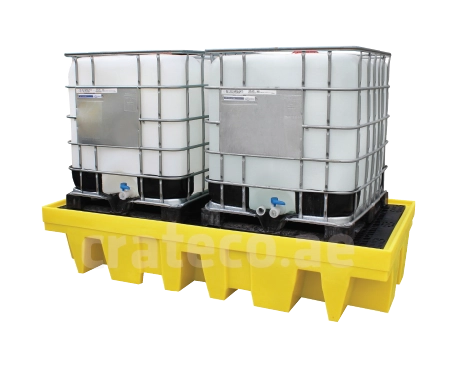
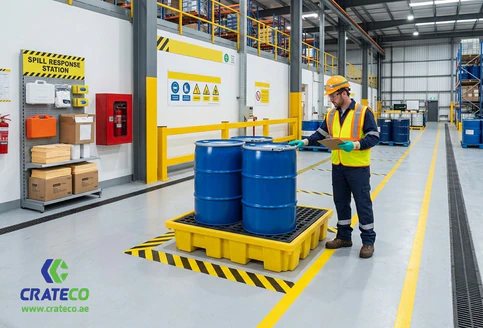
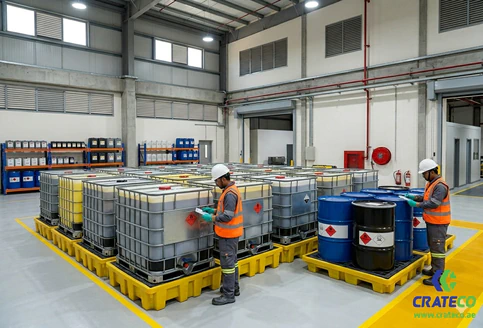
Every site storing hazardous liquids in IBCs must install secondary containment. This is a physical barrier. It catches spills before they reach the floor, drain, or soil.
The rule across the industrial zones is clear. The secondary containment system must hold at least 110% of the largest single container's volume. For a 1,000-litre IBC, the spill pallet must hold at least 1,100 litres.
This standard matches global rules in the EPA's hazardous waste storage code (40 CFR 264.175). UAE facility inspections by DCD and municipality auditors apply it directly.
IBC tanks stored outside need dedicated bunded areas. A bunded area is a sealed concrete zone with solid walls and a drainage control valve. The bund material must be compatible with the stored chemical.
Dubai's industrial waste management regulations state that bunded areas must hold 110% of the largest container's volume. Entry must be access-controlled. Labels must be visible at every entry point.
Summer heat goes above 45 degrees Celsius from June through September. This breaks down HDPE bottle walls, label adhesives, and bund seals faster than in most other climates. Shade outdoor IBC storage or move containers indoors during these months.
The Dubai Dangerous Goods Code requires 3 to 10 metres of separation between incompatible hazard classes. Fire-rated walls can replace physical distance where space is limited.
The 6 most common incompatible pairings in industrial warehouses are:
| Chemical Pairing | Hazard Classes |
|---|---|
| Flammable solvents and oxidising agents | Class 3 & Class 5.1 |
| Acids and alkaline corrosives | Class 8 |
| Toxic liquids and food raw materials | — |
| Reactive chemicals and water-based products | — |
| Petroleum hydrocarbons and organic peroxides | — |
| Agrochemicals and industrial lubricants | — |
Each pair needs its own defined storage zone. Placing them on a shared spill pallet is a direct compliance violation.
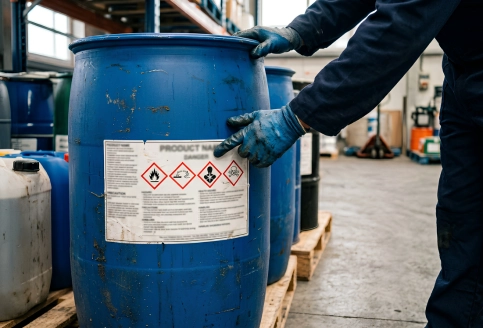
All IBC tanks must show GHS-compliant hazard labels. These include the correct UN number, hazard class diamond, and handling pictograms. SDS documents in both Arabic and English must be kept at the storage point for every chemical.
Labels break down fast in extreme conditions. UV exposure, heat, and chemical vapours destroy adhesives within 6 to 12 months on outdoor containers. DCD inspectors check label clarity and SDS dates. An SDS older than 5 years triggers a compliance flag.
Civil defence rules require all chemical storage sites to have the following in place:
| Requirement | Detail |
|---|---|
| Spill Response Kits | On-site kits matched to the specific chemicals stored |
| Fire Suppression Systems | Suited to the chemical class — sprinklers, foam, or CO2 |
| HAZCOM & Spill Response Training | Documented training for all staff who handle chemicals |
| Emergency Drills | Annual drills with written records kept on file |
An IBC spill pallet is the most practical secondary containment option for 1,000-litre IBCs in UAE sites. Check these 4 factors before buying:
| # | Factor | What to Check |
|---|---|---|
| 1 | Sump Capacity | Must exceed 1,100 litres. Many pallets sold in markets only hold 400–600 litres. Always read the technical spec sheet — do not rely on the product name alone. |
| 2 | Material Compatibility | Polyethylene (PE) pallets resist most acids, alkalis, and solvents. Steel pallets suit flammable liquids where static grounding is needed. Cross-check the chemical resistance chart with your SDS. |
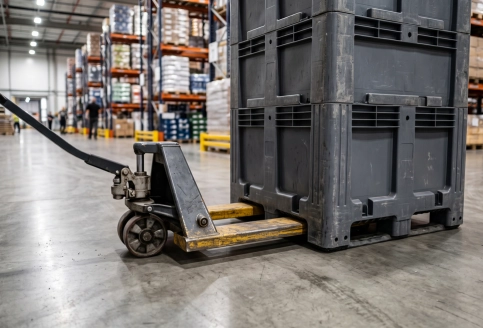
| 3 | Forklift Access | A pallet with no forklift pockets forces manual tipping. Manual tipping is one of the top causes of IBC spills in loading bays. |
| 4 | Configuration | Single IBC pallets (1,680 x 1,680 x 700 mm) suit one active container at a time. Double pallets work where 2 full containers run at once. Large setups often use bunded sump flooring for continuous floor-level containment. |
Follow these 6 practices to stay compliant all year:
| # | Best Practice | What It Means |
|---|---|---|
| 1 | Inspect IBCs Before Every Fill Cycle | Check the inner bottle for cracks, colour change, or swelling. Check the cage frame for rust and broken welds. Pull damaged IBCs from service right away. |
| 2 | Verify Chemical Compatibility Before Reusing IBCs | The 3 most common reuse errors are: storing a different chemical class without compatibility checks, skipping the flush-out step, and missing residual reaction risks inside the bottle. |
| 3 | Keep IBCs on Spill Pallets During Dispensing | Most spills happen during filling and dispensing. The IBC must stay on its containment pallet through the full active use cycle — not just during storage. |
| 4 | Protect IBCs From Direct Sunlight (June–September) | UV breaks down HDPE bottles faster in UAE summers. Use shade structures or indoor storage during these months. |
| 5 | Label Every IBC at the Filling Point | Inspectors cite sites for unlabelled IBCs moving between filling stations and storage bays. Apply the label at the point of filling, not at the destination. |
| 6 | Keep Inspection Records for at Least 3 Years | DCD and Dubai Municipality audits ask for records of container checks, chemical changes, training logs, and SDS updates. Three years is the minimum retention period. |
Dubai's dangerous goods storage regulations confirm that breaking civil defence or municipality rules results in:
| Consequence | Detail |
|---|---|
| Financial Fines | AED 1,000 to AED 1,000,000 under Law No. 4 of 2025 |
| Doubled Fines | Each repeat offence doubles the original fine |
| Operational Shutdown | Suspension of warehouse and trade operations |
| Criminal Liability | Applies where spills cause injury or environmental harm |
| Voided Insurance | Fire and environmental incident claims become invalid |
One compliance failure can also cut off trade relationships. Many international freight and logistics partners ask for proof of regulatory compliance before working with UAE storage sites.
Chemical storage regulations exist to protect workers, property, and the environment. Following them is not optional. Every facility that stores hazardous liquids needs the right IBC tanks, proper spill containment, and up-to-date documentation.
The cost of getting it right is far lower than the cost of getting it wrong. A compliant setup avoids fines, shutdowns, and legal liability. Start with the right containers and the right containment, and the rest of your compliance process becomes much easier.
The spill pallet must hold at least 110% of the largest single container's volume. For a 1,000-litre IBC, the sump must hold at least 1,100 litres.
Yes. UAE civil defence and free zone bodies require UN-certified IBCs for all dangerous goods storage. Using non-certified containers is a direct violation.
Check IBCs before every fill. Run formal documented checks monthly. The UN Model Regulations require periodic re-testing at set intervals. An IBC must not be filled after its last inspection date has passed.
The Dubai Dangerous Goods Code requires 3 to 10 metres between incompatible hazard classes. Fire-rated walls can substitute where distance is not possible.
Spills reach drains, soil, and groundwater. This triggers environmental liability under Federal Law No. 24 of 1999, DCD enforcement, possible criminal charges, and voided insurance.