
If you move, store, or ship goods in any quantity, pallets are a core part of your operation. Choosing the wrong type can slow handling, damage products, or cause safety checks to fail during export. The right pallet makes loading faster, storage safer, and transport more efficient from start to finish.
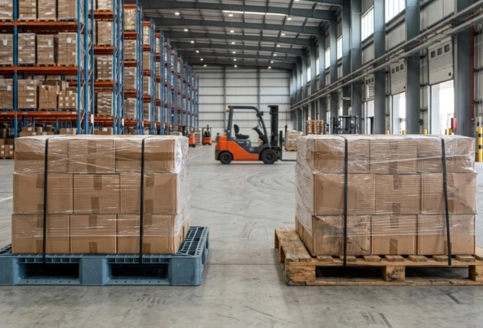
A pallet is a flat platform used to stack, store, protect, and transport goods. It acts as a base that allows forklifts, pallet jacks, and conveyor systems to lift and move loads without direct contact with the floor. Pallets are categorized by their construction materials and their structural styles, which dictate entry points and deck designs.
If you are sourcing pallets for your business, working with a reliable plastic pallet supplier in the UAE ensures you get the right type for your load, environment, and handling method. Choosing the right pallet type optimizes both storage efficiency and transit safety.
Pallets are primarily classified by the material used to build them. Each material serves different logistical needs, and understanding the differences helps you pick the right one for your operation.
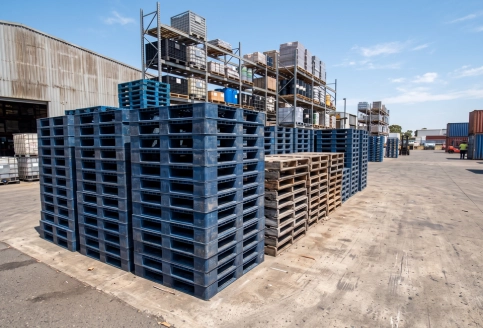
Wooden pallets are the industry standard, accounting for 90 to 95 percent of the global pallet market. They are cost-effective, strong, easily repaired, and recyclable. Their low purchase price makes them a common choice for one-time domestic shipments and general cargo transport.
However, wooden pallets absorb moisture over time, which weakens their structure and creates conditions for mold, bacteria, and pest infestation. They also carry the risk of nails and splinters, which can injure workers or damage packaged goods.
For international export, wooden pallets must comply with ISPM 15, an international phytosanitary standard that requires heat treatment or fumigation before crossing borders, which adds time and cost to the shipping process.
Best for: One-time domestic shipments, construction materials, general cargo, low-budget operations.
Not ideal for: Food and pharmaceutical industries, export without fumigation, humid or wet environments.
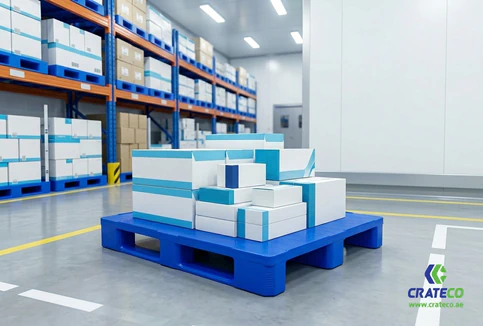
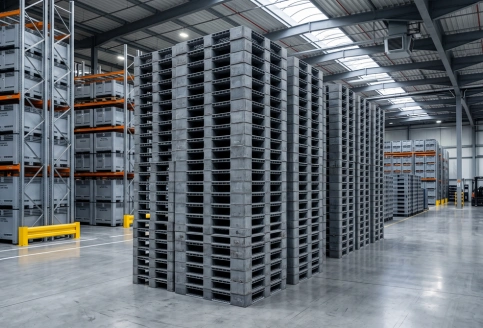
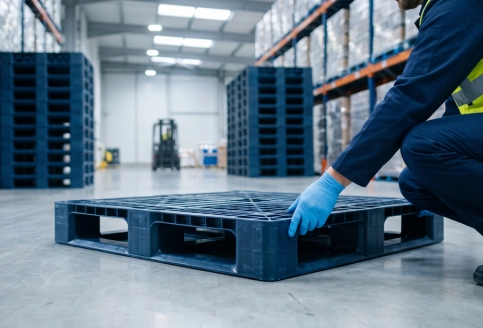
Plastic pallets are preferred for hygiene-sensitive industries such as pharmaceuticals, food processing, and beverages. They are moisture-resistant, non-porous, and last significantly longer than wooden pallets.
Unlike wood, plastic does not absorb liquids, harbor bacteria, or require fumigation for international export. They are more expensive upfront but deliver better value over time due to their long lifespan and low maintenance needs. These are covered in full detail in a dedicated section further below.
Best for: Food, pharma, cold chain, logistics, warehousing, export.
Not ideal for: Very low-budget, single-use applications where cost per trip matters more than durability.
Metal pallets, made from steel or aluminium, are the heaviest and most durable option available. They handle extreme weights without bending and are used in closed-loop industrial systems where pallets stay within a controlled facility.
Steel pallets are also fireproof, which makes them suitable for environments storing flammable materials. However, their significant weight increases transport fuel costs and makes manual handling difficult.
Steel can also rust if the protective coating wears off, particularly in outdoor or high-humidity environments. Aluminium pallets are lighter than steel but considerably more expensive.
Best for: Heavy industrial loads, automotive manufacturing, military supply chains, fire-risk environments.
Not ideal for: Food and pharmaceutical use, lightweight handling, outdoor storage without protective coating.
Paper pallets, also called corrugated or presswood pallets, are lightweight and eco-friendly. They are used primarily for lightweight air freight or one-way shipping to avoid return-freight costs.
Because they are fully recyclable and biodegradable, they appeal to businesses with strong sustainability goals. However, their load capacity is very limited, and they are highly vulnerable to moisture damage, which makes them unsuitable for heavy goods or repeated use.
Best for: Air freight, lightweight goods, single-use export shipments, sustainable packaging initiatives.
Not ideal for: Heavy loads, outdoor storage, humid environments, repeated daily operations.
Beyond material, pallets also differ in their structural style. The style refers to the deck configuration and how forklifts or pallet jacks can access them. This affects handling speed, warehouse layout compatibility, and load security.
How a forklift or pallet jack enters the pallet is one of the most important practical considerations in warehouse operations.
It allows forklift access from only two opposite sides. These are common in operations where pallets are always positioned in a fixed direction and handling equipment approaches from a consistent angle. They are simple in construction and work well in standard racking systems.
This allows forklift or pallet jack entry from all four sides, offering higher operational efficiency and maneuverability. These are preferred in busy warehouses where pallets need to be picked up or repositioned quickly from any direction without rotating the load.
The top surface of a pallet, called the deck, can be open or closed depending on the application.
Features gaps or spaces between the top deck boards. This design saves weight, reduces material costs, and improves airflow, making it well-suited for agricultural produce or chilled goods that need ventilation during storage and transport.
A continuous, smooth surface with no gaps across the top. It prevents small items from falling through, provides a stable base for all product types, and is much easier to sanitize thoroughly. This is the standard choice in food processing, pharmaceutical, and clean-room environments.
Pallets also differ in whether they have a deck on one side or both.
It features a top deck only, with no bottom deck. They are lighter, cost 20 to 30 percent less than double-face pallets, and are mainly used for one-way shipping where the pallet is not returned.
They have both a top and a bottom deck. These can be non-reversible, meaning only one side is designed for use, or reversible, meaning the pallet can be flipped and used from either side. Reversible pallets effectively double the usable life of the product.
They have top deck boards that overhang the structural supports on the sides. This creates a wing or ledge that allows strapping or banding to be applied around the load without cutting into the goods, which is useful for securing irregularly shaped cargo.
The internal structure of a pallet determines its strength, weight distribution, and forklift compatibility.
These pallets use solid boards called stringers running lengthwise between the top and bottom decks. These stringers carry the load and provide the entry points for forklifts. They are simpler to manufacture and are the most common construction style for wooden pallets.
They are supported by 9 or 12 solid blocks placed at the corners, edges, and center rather than continuous stringers. This construction allows seamless 4-way forklift entry from all sides and distributes the load more evenly.
Block pallets are generally stronger and more stable than stringer pallets under heavy loading conditions.
Now that you understand all pallet materials and structural styles, it is clear that plastic pallets stand out as the superior choice for most modern industries. Here is why plastic consistently outperforms every other material across the factors that matter most in day-to-day operations.
| Feature | Plastic Pallets | Wooden Pallets | Metal Pallets | Paper Pallets |
|---|---|---|---|---|
| Hygiene | Excellent, non-porous, easy to sanitize | Poor, absorbs moisture and bacteria | Moderate, can rust | Moderate, absorbs moisture |
| Durability | Very high, hundreds of use cycles | Moderate, breaks, and splinters over time | Extremely high but heavy | Very low, single-use |
| Weight | Lightweight | Medium | Very heavy | Very light |
| Export Compliance | No fumigation needed | Requires ISPM 15 treatment | No restriction | No restriction |
| Safety | No nails or splinters | Risk of nails and splinters | Sharp edges possible | Generally safe |
| Weather Resistance | Excellent | Weakens with moisture | Rusts without coating | Fails in moisture |
| Recyclability | Fully recyclable | Often sent to landfill | Recyclable but heavy | Biodegradable |
| Long-Term Cost | Lower cost per use over time | Higher replacement cost | High upfront cost | High per-use cost |
Plastic pallets are non-porous, which means they do not absorb liquids, bacteria, or odors. This makes them the safest and most compliant choice for food-grade, pharmaceutical, and cold chain operations.
They do not require fumigation for export, which saves time and money on international shipments. Every plastic pallet has the same weight and dimensions, which is critical for automated warehouse systems, racking, and conveyor compatibility.
And because they last for hundreds of use cycles without splinting, rusting, or rotting, the cost per trip over their lifetime is far lower than any disposable alternative.
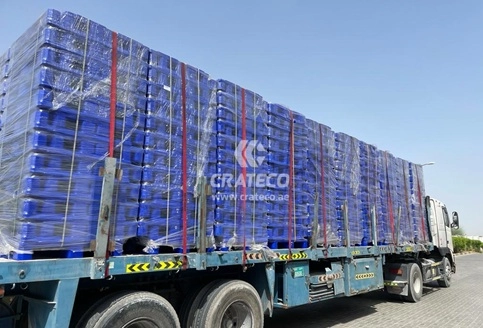
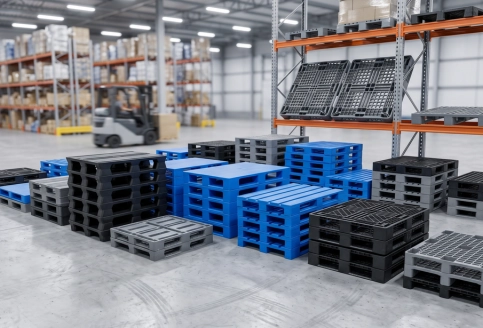
Crateco Pack LLC offers a complete range of plastic pallets to cover every industry need, load requirement, and handling environment. All pallets are made from high-density polyethylene (HDPE) or polypropylene (PP) with UV stabilizers for long outdoor life.
Light-duty pallets are designed for loads that do not require heavy structural support. They are lighter in weight, easier to carry manually, and cost-effective for operations that involve frequent movement of smaller or lighter goods.
These are commonly used in retail stores, display areas, small distribution centres, and light manufacturing units. Despite being lighter, they still offer good stackability and work with standard pallet jacks. Light-duty pallets are a practical choice when the priority is easy handling rather than maximum load capacity.
Medium-duty pallets are suitable for a wide range of applications, including general warehouse storage, distribution, and supply chain operations. They can handle moderate loads and work well with both forklifts and pallet jacks.
These are a popular all-round choice for businesses that need reliable pallets for daily operations without the added cost of heavy-duty variants.
Medium-duty options are available in standard sizes like 1200x1000mm and Euro size 1200x800mm, making them compatible with most warehouse systems across the UAE and internationally.
Heavy-duty pallets are built to carry large, heavy loads and to perform in racking systems where the pallet is supported only at its runner ends rather than across the full base.
This puts significant stress on the pallet structure, so rackable models include steel-reinforced bars inside the runners to prevent bending or deflection under load. They are used in large warehouses, industrial storage facilities, cold storage units, and high-volume logistics operations.
Crateco Pack LLC's heavy-duty rackable pallets come in 3-runner and 5-runner designs, with options for 3, 4, or 5 steel rods depending on the required load rating.
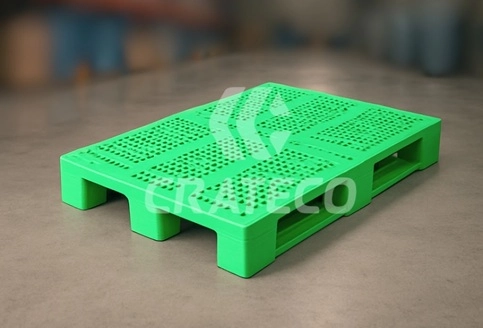
Flat or hygienic pallets have a fully closed top and bottom deck with no gaps or openings. This design prevents dust, dirt, and liquid from entering the pallet structure, making it much easier to clean thoroughly.
They are the standard choice in food processing plants, dairy facilities, pharmaceutical production, and any environment where contamination control is critical.
Many models include safety rims around the edges to stop goods from sliding off during movement. These pallets are also used in cold rooms and clean rooms where surface cleanliness must meet strict regulatory standards.
Vehicle or floor pallets are low-profile platforms designed to sit flat on the floor or inside vehicles without the need for forklift access from below. They have a very low height, typically around 75mm, which makes them ideal for loading into trucks, vans, or containers where vertical space is limited.
They are also used in cold storage rooms to keep goods elevated above the floor surface, protecting products from ground-level moisture.
The anti-slip grip surface on these pallets keeps loads stable during transit, which is especially important when transporting fragile or loosely stacked goods.
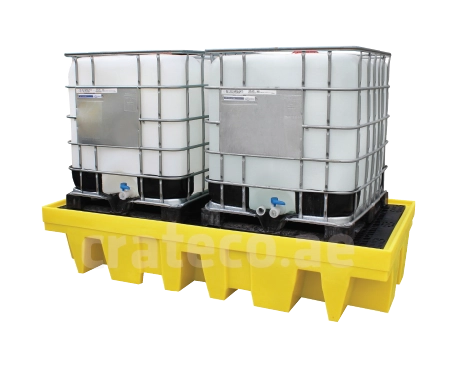
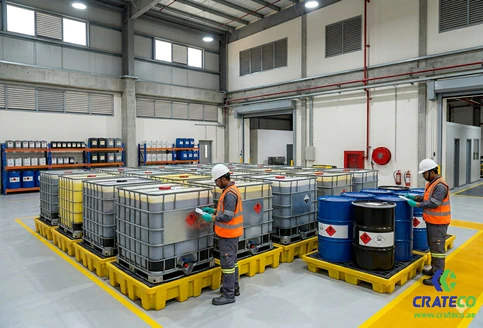
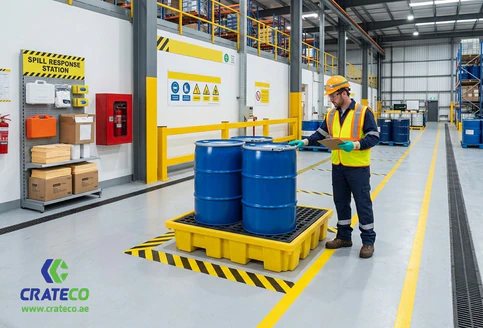
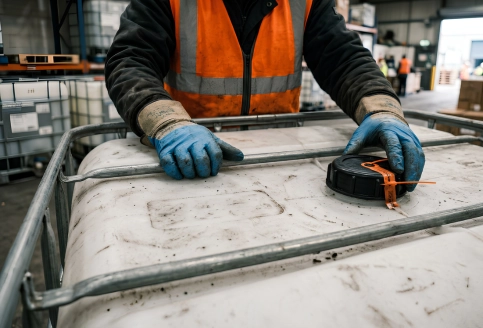
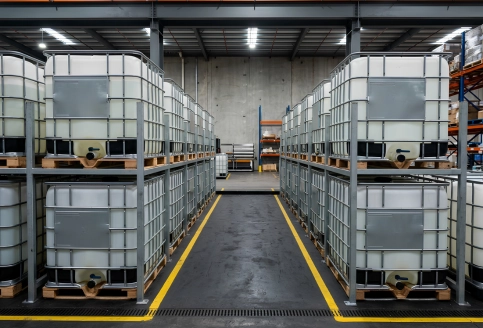
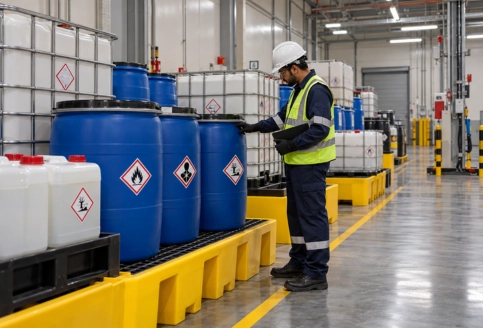
Spill pallets are a specialised type designed to contain liquid spills from drums, containers, or IBC tanks stored on top of them. They have a raised grated surface that holds the containers and a built-in sump below that collects any leaked liquid.
This prevents hazardous chemicals, oils, or industrial liquids from spreading across the floor and causing safety risks or environmental violations. Spill pallets are a regulatory requirement in many facilities that store chemicals, lubricants, fuels, or cleaning agents.
They come in different sizes to accommodate one, two, or four drums, depending on your storage volume.
| Pallet Type | Common Size (LWH mm) | Duty Level | Forklift Entry | Steel Option |
|---|---|---|---|---|
| 3 Runner Standard | 1200 x 1000 x 150 | Medium | 2-way | Yes |
| 3 Runner Euro | 1200 x 800 x 150 | Medium | 2-way | Yes |
| 5 Runner Standard | 1200 x 1000 x 150 | Heavy | 2-way | Yes |
| 6 Runner Heavy Duty | 1200 x 1000 x 150 | Very Heavy | 2-way | Yes |
| 3 Runner Flat Hygienic | 1200 x 1000 x 160 | Medium-Heavy | 2-way | Yes |
| 9 Leg Nestable | 1200 x 1000 x 140 | Light-Medium | 4-way | No |
| 9 Leg Flat Hygienic | 1200 x 1000 x 130 | Medium | 4-way | No |
| Reversible Pallet | 1200 x 1000 x 150 | Medium | 2-way | No |
| Display Pallet | 800 x 600 x 150 | Light | Nestable | No |
| Vehicle Floor Pallet | 1200 x 1000 x 75 | Light-Medium | Manual/Forklift | No |
| Spill Pallet | Varies | Containment | Forklift | No |
Pallets come in many materials and structural styles, each with its own strengths and limitations. Wooden pallets are widely used but require fumigation for export and weaken with moisture. Metal pallets are extremely strong but heavy and expensive. Paper pallets are lightweight and eco-friendly but cannot handle heavy loads or repeated use.
Plastic pallets stand above all other types for most modern operations. They are hygienic, durable, moisture-resistant, and export-ready without any fumigation requirement.
For businesses across the UAE looking for reliable, high-quality pallet solutions, Crateco Pack LLC is the trusted choice. As a leading plastic pallets supplier and manufacturer in the UAE, we offer pallets across all duty levels, styles, and sizes.