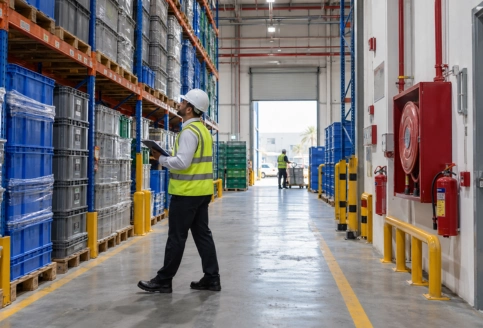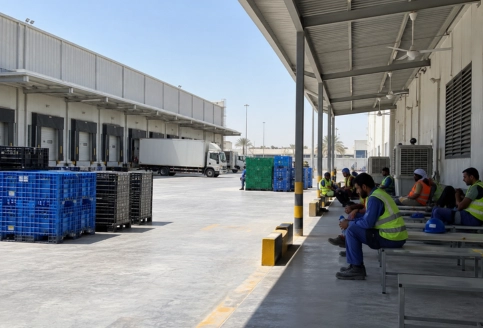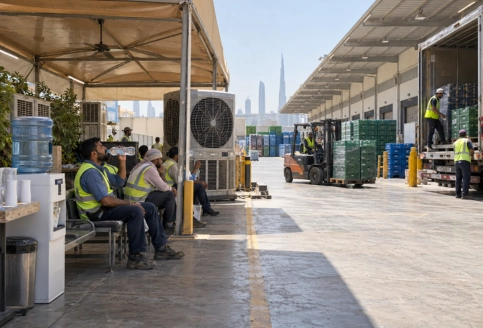

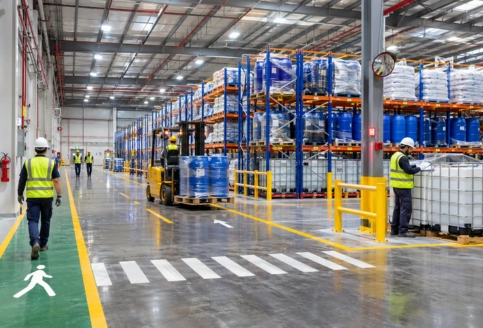
Most warehouses have safety rules pinned to a wall. Far fewer have a system that checks whether those rules work. That gap is exactly what ISO 45001 was written to close.
ISO 45001 is the international standard for occupational health and safety management systems. For a warehouse, it means running safety the same way you run inventory: identify the risks, plan controls, train people, measure results, and improve.
It is voluntary in the UAE, but it maps closely onto the employer duties in Federal Decree-Law No. 33 of 2021, and many large buyers and tenders now ask for it.
Workplace harm is far bigger than most managers assume. The International Labour Organization estimates that 2.93 million workers die each year from work-related factors. Another 395 million suffer non-fatal work injuries annually.
Adoption of the standard is growing fast. The 2024 ISO Survey counted 542,527 valid ISO 45001 certificates covering roughly 969,000 sites worldwide. Construction leads the count, but logistics, manufacturing and warehousing are major users.
ISO 45001 was published in March 2018 and replaced the older OHSAS 18001, which was withdrawn in 2021. In 2024, ISO added an amendment asking organisations to consider whether climate change is relevant to their safety risks, which matters in a hot climate like the UAE's.
The standard does not replace UAE law. It gives you a structure for meeting it. Article 13 of Federal Decree-Law No. 33 of 2021 requires employers to protect workers from injury and occupational disease. The federal health and safety rules are filled out by Cabinet Resolution No. 1 of 2022 and Administrative Decision No. 19 of 2023.
Emirate and free zone rules sit on top. Abu Dhabi uses the OSHAD framework. Dubai Municipality and free zones such as JAFZA run their own health and safety requirements. An ISO 45001 system gives one framework that can absorb all of these, so audits from different authorities draw on the same records.
ISO 45001 follows the same high-level structure as ISO 9001 and ISO 14001, with requirements in clauses 4 to 10. Here is how they translate into daily warehouse work.
| Clause | Requirement | Warehouse example |
|---|---|---|
| Context | Understand internal and external issues and interested parties | Summer heat, midday break rules, shift patterns, client safety demands |
| Leadership and worker participation | Top management owns safety and consults workers | Safety committee with pickers, drivers and supervisors |
| Planning | Identify hazards, assess risks and legal obligations, set objectives | Risk register covering forklifts, racking, manual handling and chemicals |
| Support | Resources, competence, awareness, communication, documents | RTA forklift licences, toolbox talks, signage in several languages |
| Operation | Control risks, manage change, contractors and emergencies | Pedestrian zones, spill response, contractor permits, fire drills |
| Performance evaluation | Monitor, measure, audit and review | Near-miss tracking, monthly inspections, internal audits |
| Improvement | Investigate incidents, correct and improve | Root cause analysis after a pallet collapse, updated procedures |
Worker participation is what sets ISO 45001 apart. It requires non-managerial workers to be consulted on hazards, controls and training. In practice, the people who walk the aisles every day often spot risks that managers miss.
ISO 45001 asks organisations to reduce risk using a set order of controls. The most effective options come first. Warehouses often jump straight to PPE, which is the weakest option.
| Control level | What it means | Warehouse example |
|---|---|---|
| Elimination | Remove the hazard entirely | Store heavy items at waist height so no lifting from the floor is needed |
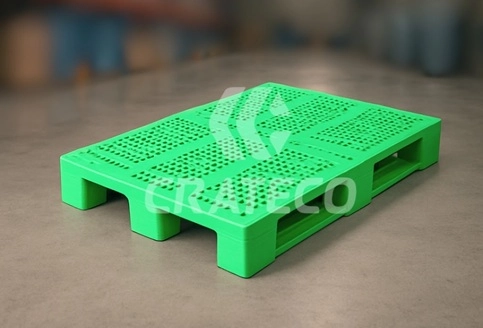
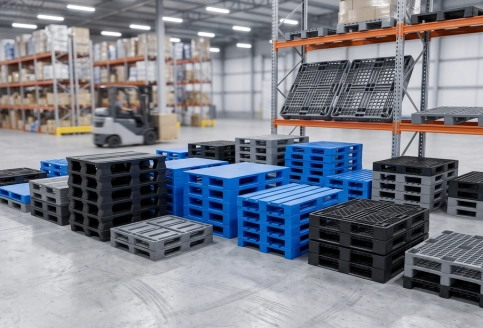
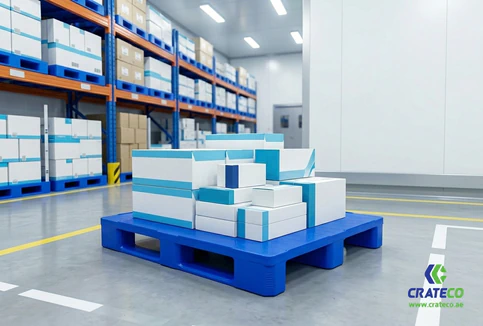
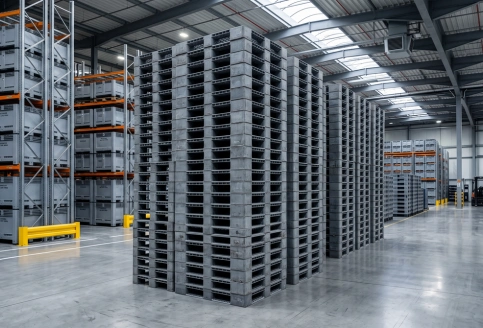
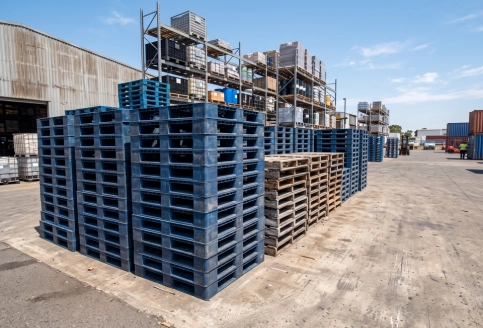
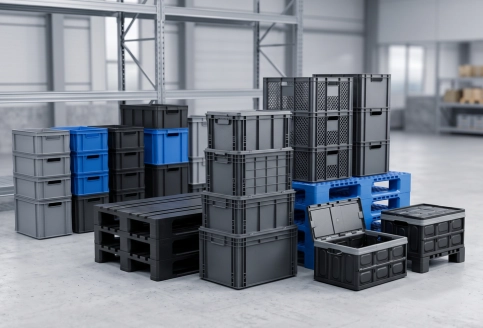
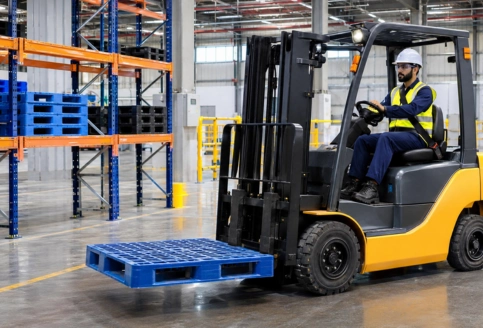
| Substitution | Replace with something less hazardous | Swap splintering wooden pallets for plastic pallets |
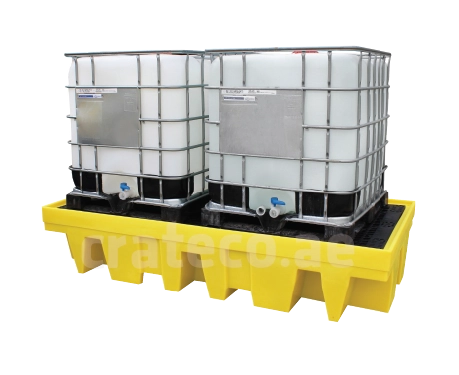
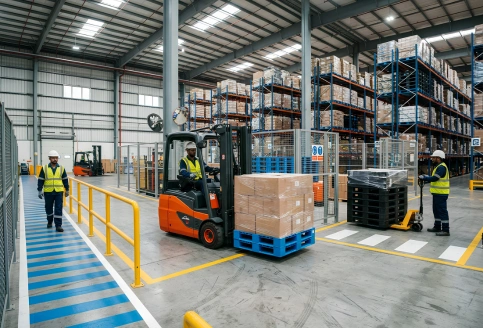
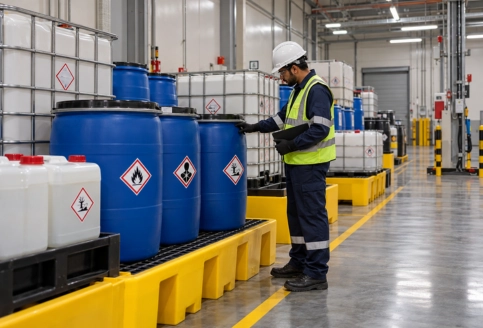
| Engineering controls | Isolate people from the hazard | Barriers between forklift lanes and walkways, spill pallets under drums |
| Administrative controls | Change how work is done | Job rotation, one-way traffic routes, permit systems |
| PPE | Protect the individual | Safety shoes, gloves, high-visibility vests |
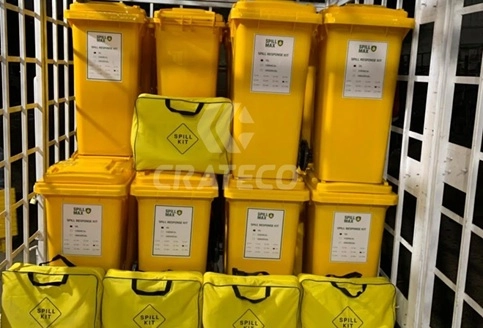
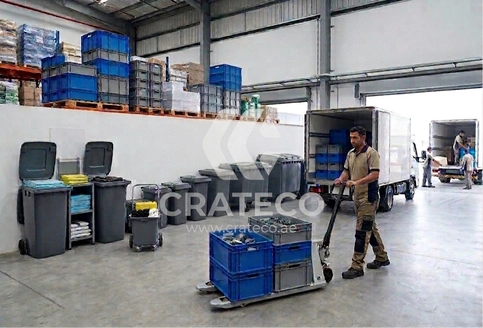
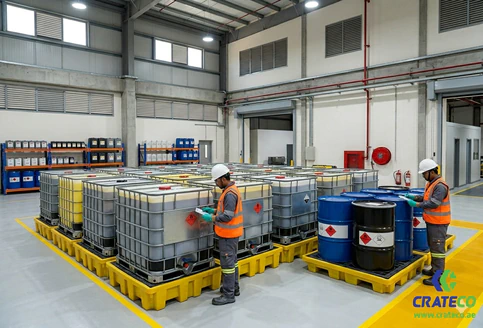
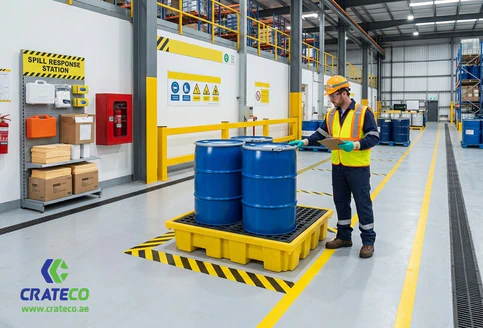
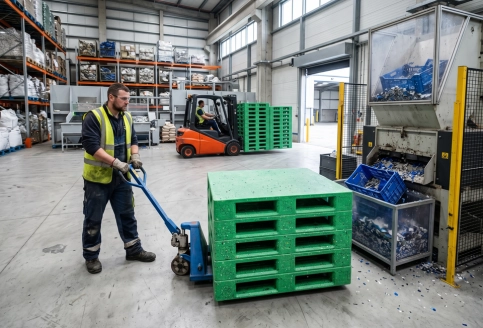
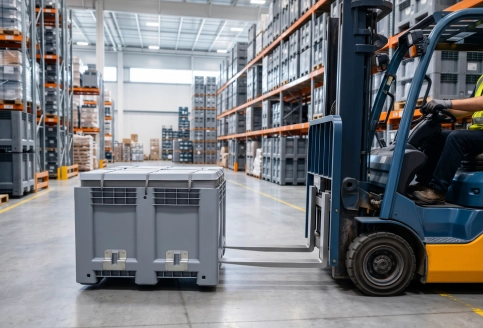
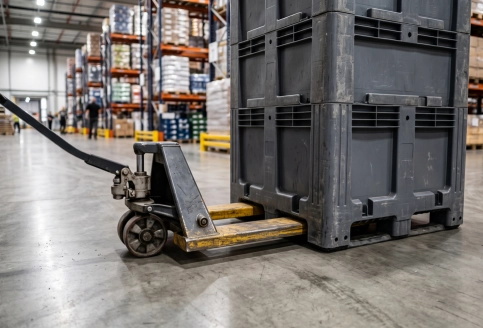
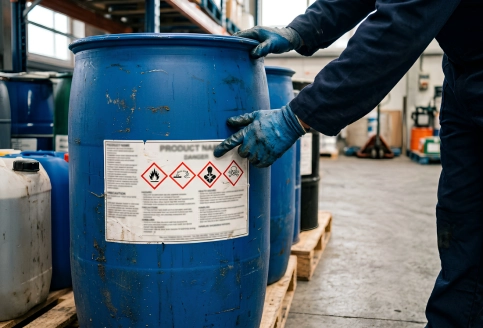
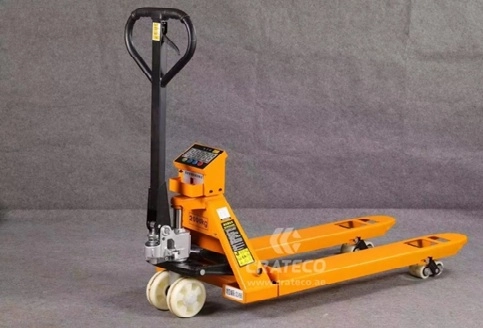
Many of the strongest controls are equipment choices. Placing chemical drums on spill pallets is an engineering control that contains leaks at the source. Replacing heavy manual carrying with trolleys and pallet trucks reduces strain injuries, as our post on manual handling explains.
Certification is optional. A warehouse can follow ISO 45001 without being certified. Formal certification, though, gives third-party proof that buyers and insurers recognise.
The typical path looks like this:
1. Gap analysis. Compare current safety practice against each clause.
2. Implementation. Build the risk register, procedures, training and records. Many mid-sized sites need several months.
3. Internal audit and management review. Test the system before outside auditors arrive.
4. Stage 1 audit. The certification body reviews documents and readiness.
5. Stage 2 audit. Auditors check that the system works in practice on the floor.
6. Surveillance. Certificates usually last three years, with yearly surveillance audits.
Choose a certification body accredited by a recognised accreditation body. In the UAE, the Emirates International Accreditation Centre (EIAC) accredits certification bodies, and international accreditation under the IAF is also widely accepted.
Many of these overlap with civil defence and municipality checks. Our guide to compliance audits covers what those inspectors look for.
No, it is a voluntary standard. However, UAE law already requires employers to provide a safe workplace, and ISO 45001 offers a proven structure for meeting those duties. Many large clients and government tenders also ask suppliers for it.
ISO 45001 replaced OHSAS 18001, which was withdrawn in 2021. ISO 45001 places more weight on leadership, worker participation and managing risks and opportunities, and it shares a common structure with ISO 9001 and ISO 14001.
It depends on the size of the site and how mature current safety practices are. Many mid-sized warehouses need several months to build the system and gather records, followed by the two-stage certification audit.
Yes. All three share the same high-level structure, so many companies run one integrated management system. This cuts duplicate paperwork and allows combined audits covering quality, environment and safety together.
Yes, indirectly. The standard requires you to identify all significant hazards, and since 2024 it asks organisations to consider climate change. In the UAE, heat stress is a clear risk that belongs in the risk register and control plan.
ISO 45001 turns warehouse safety from a set of rules into a managed system. It fits neatly over UAE OSH law, gives workers a voice, and pushes controls up the hierarchy from PPE toward real engineering fixes.
Certification adds proof that buyers can trust. Many of the most effective controls start with the right equipment. Find spill containment, pallets, and handling gear for a safer site in the spill control range from Crateco Pack LLC.