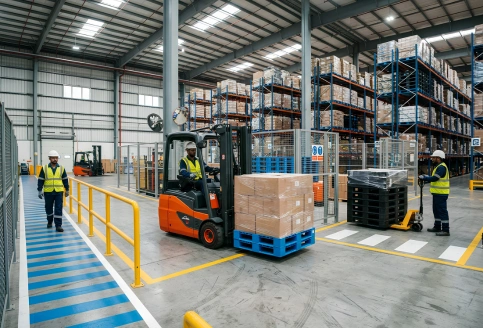

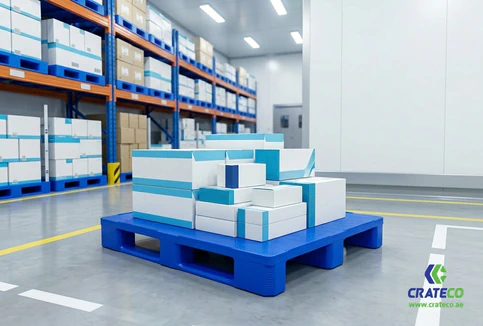
The UAE pharma market was worth USD 4.15 billion in 2024. It is expected to hit USD 8.02 billion by 2033 (IMARC Group). That kind of growth puts a lot of pressure on warehouses to stay compliant.
Pharmaceutical storage in the UAE must meet EDE, GDP, and GMP standards. These cover temperature, hygiene, pallet quality, and documentation. Missing any one of them can lead to an audit failure, a product recall, or a licence suspension.
This article explains what those standards are, how hygienic pallets support them, and what UAE warehouse operators need to do to stay compliant.
In January 2025, a new pharmaceutical law came into force in the UAE. It is called Federal Decree-Law No. 38 of 2024. This law created the Emirates Drug Establishment, or EDE, as the main authority for pharmaceutical regulation.
By 29 December 2025, the EDE had taken over 44 services from MOHAP. These include warehouse licensing, GMP and GDP certification, and import/export permits.
Every pharmaceutical warehouse in the UAE now needs a valid EDE licence. This applies to facilities in Dubai, Abu Dhabi, Sharjah, Jebel Ali Free Zone, and Ras Al Khaimah.
The licence is not just paperwork. EDE auditors do physical checks. Your facility has to meet GMP and GDP requirements in real life, not just in documents.
GDP stands for Good Distribution Practice. It sets out how medicines must be received, stored, handled, and dispatched. The WHO published the core GDP guidelines in Annex 5 of its Technical Report Series 957. UAE authorities use these as their benchmark.
Here is what GDP requires for storage areas:
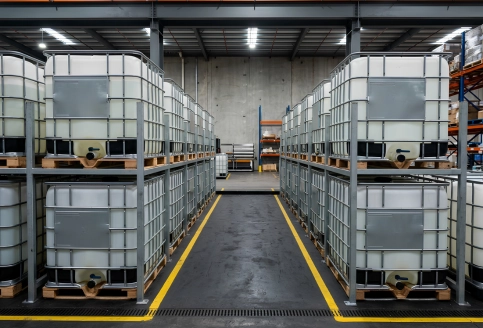
Storage areas must be clean and free from waste and pests.
Pallets must be kept in a good state of cleanliness and repair.
Temperature and humidity must be controlled and logged.
All handling must be documented and traceable.
Receiving and dispatch areas must protect products from the weather.
These are not suggestions. They are checked during EDE inspections.
Many pharmaceutical warehouses in JAFZA and other UAE free zones go beyond basic GDP. They seek GSDP accreditation. GSDP stands for Good Storage and Distribution Practices. It is issued by the UAE Ministry of Health.
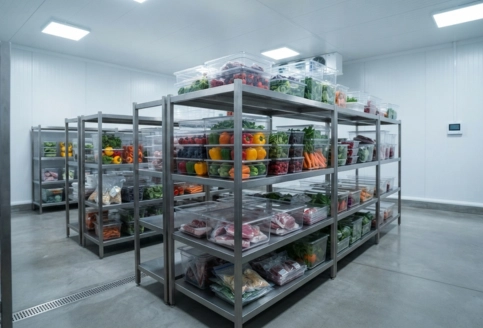
A GSDP-accredited facility must keep ambient products between +15°C and +25°C. Cold chain products like vaccines need +2°C to +8°C storage.
GSDP accreditation covers hygiene standards, pallet condition, temperature control, and documented handling. It is the gold standard for pharmaceutical warehousing in the UAE.
Dubai can hit 48°C outdoors in summer. Inside uninsulated warehouse areas, temperatures can go above 50°C. This makes temperature control a serious operational challenge.
Here are the required storage temperatures for different pharmaceutical products:
| Product Type | Temperature | Humidity |
|---|---|---|
| Ambient pharmaceutical products | +15°C to +25°C | 40% to 60% RH |
| Vaccines and refrigerated biologics | +2°C to +8°C | Controlled |
| Deep-frozen products | -20°C or lower | Controlled |
| Ultra-low temperature biologics | -70°C to -80°C | Controlled |
Temperature control is a legal requirement under UAE pharmaceutical regulations. It is not optional.
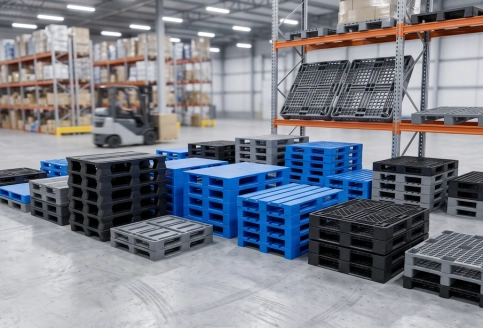
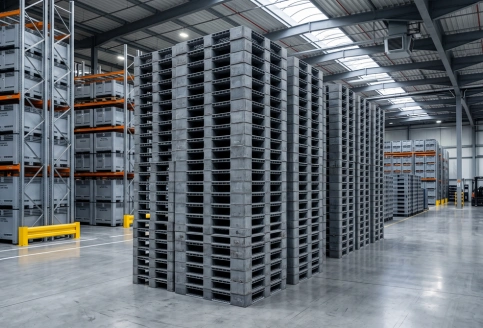
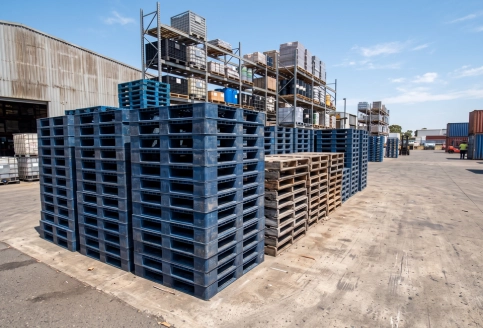
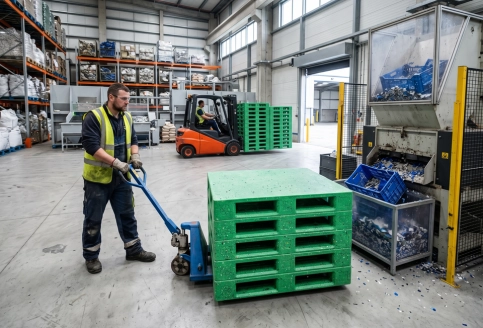
Pallets sit under every medicine carton in your warehouse. They are the base layer of your storage operation.
The WHO GDP guidelines state directly that pallets must be clean and in good repair. A pallet that cannot be properly cleaned or that sheds particles is a compliance failure. It is also a product safety risk.
EDE inspectors check pallets physically during audits. A damaged or unhygienic pallet is an audit observation waiting to happen.
Not every pallet meets pharmaceutical storage standards. Here are the 7 requirements a pallet must meet to be used in a compliant UAE pharmaceutical warehouse:
1. Non-porous surface: The pallet must not absorb liquids or moisture. High-density polyethylene (HDPE) or polypropylene construction meets this standard.
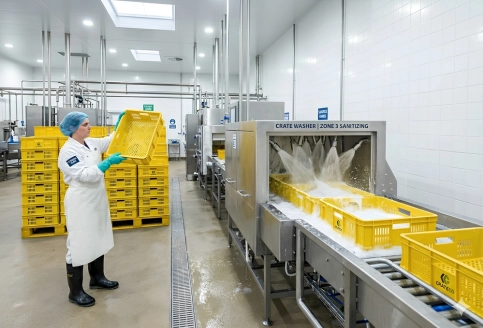
2. Washable and sterilisable: The pallet must handle high-pressure washing, steam cleaning, and chemical disinfection. This supports the regular cleaning SOPs required under GDP.
3. Virgin or pharmaceutical-grade material: The pallet must be made from virgin HDPE or certified pharmaceutical-grade plastic. This removes the risk of chemical migration from recycled material into product packaging.
4. No particle shedding: One-piece moulded plastic pallets do not shed fragments. This is critical in facilities handling pharmaceutical packaging.
5. Consistent dimensions: The pallet must hold its exact shape throughout its service life. This keeps it compatible with racking, forklifts, conveyors, and automated systems.
6. Chemical resistance: The pallet must resist bleach, isopropyl alcohol, and enzyme-based cleaners used in pharmaceutical sanitation.
7. UV and heat stability: UAE loading docks can exceed 45°C in summer. The pallet must not warp, crack, or shed particles under heat and UV exposure.
1. Cuts contamination risk at the storage layer: Non-porous surfaces stop moisture and chemical residues from building up under product cartons. This supports the contamination control strategy required under PIC/S GMP Annex 1, which came into force on 25 August 2023.
2. Reduces audit risk: Clean, certified, pharmaceutical-grade pallets give EDE inspectors visible proof of GDP compliance. They reduce the chance of getting an audit observation on storage hygiene.
3. Speeds up sanitation between batches: Smooth plastic surfaces wash fast and dry fast. There is no waiting time before the pallet goes back into use. This is important in high-throughput facilities in JAFZA and Dubai Industrial City.
4. Works with automated warehouse systems: Consistent pallet dimensions mean no jams on conveyor lines, no misfits in racking, and no errors in ASRS (automated storage and retrieval systems). UAE pharmaceutical logistics hubs are investing heavily in automation. Pallets have to keep up.
5. Lowers long-term cost: Pharmaceutical-grade HDPE pallets last 7 to 10 years. That is a longer lifespan than standard pallets. Fewer replacements and no treatment costs mean a lower total cost of ownership over any five-year period.
6. Supports UAE sustainability goals: HDPE pallets are 100% recyclable. This aligns with the UAE Net Zero 2050 strategy and the Emirates Green Logistics guidelines that EDE now references in facility licensing.
The UAE climate creates 4 specific risks for pallet hygiene and compliance.
Extreme summer heat: Temperatures between 42°C and 48°C are common in Dubai, Abu Dhabi, and Al Ain from June to September. Pallets sitting on loading docks or in transitional zones are exposed to this heat for extended periods. They must not warp or crack under these conditions.
Coastal humidity: Humidity along the UAE coast reaches 80% to 90% in summer. Warehouses near Jebel Ali Port, Dubai Creek, and Hamriyah Free Zone in Sharjah are especially exposed. Pallets must not absorb this moisture under any conditions.
Desert dust: Seasonal dust storms sweep through Abu Dhabi and Al Ain. Dust settles on every surface in the warehouse. Smooth, non-porous pallet surfaces can be fully cleaned after a dust event. Rough or porous surfaces cannot.
Cold chain condensation: When pallets move between cold storage (2°C to 8°C) and ambient loading areas, condensation forms on surfaces. Hygienic plastic pallets shed this water quickly. This stops moisture from pooling under pharmaceutical cartons during dispatch.
Use these 10 checks to assess your facility against EDE and WHO GDP requirements.
EDE facility licence is current and covers all product categories handled.
Temperature mapping is documented for all storage zones, including loading dock areas.
Humidity logs show 40% to 60% RH maintained in ambient pharmaceutical zones.
Pallet hygiene SOP covers cleaning frequency, approved agents, and inspection steps.
Pallet material certificates confirm virgin HDPE or pharmaceutical-grade composition.
An active pest control contract is in place with a licensed provider, with quarterly records on file.
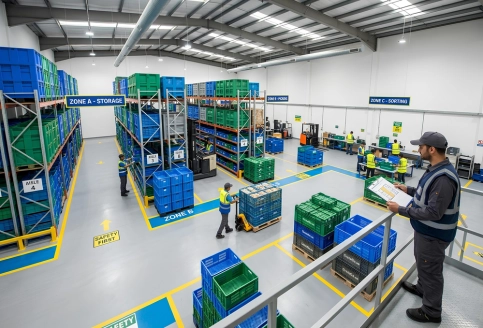
Physical segregation separates quarantine stock, returned goods, cold chain, and general pharmaceutical products.
FIFO/FEFO rotation is logged in the warehouse management system and visible on pallet labels.
GDP training records are current for all warehouse staff.
Calibration certificates for all temperature and humidity monitors are validated to EIAC standards.
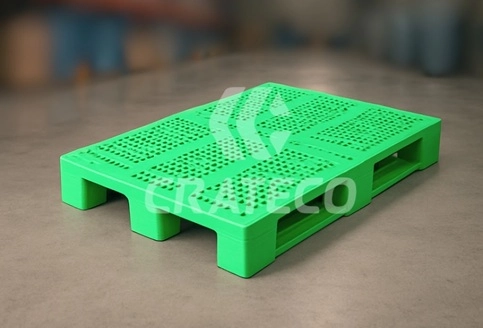
Crateco supplies pharmaceutical-grade hygienic pallets built for UAE storage conditions.
Our pallets meet EDE, GDP, GMP, HACCP, and WHO distribution practice standards. They are UV-stabilised, thermally stable to 60°C, and made from virgin HDPE.
We supply facilities across Dubai, Abu Dhabi, Sharjah, Jebel Ali Free Zone, KIZAD, and Ras Al Khaimah.
Contact Crateco today to get a product specification review for your UAE pharmaceutical warehouse.
Ambient products need +15°C to +25°C storage with 40% to 60% relative humidity. Vaccines and refrigerated biologics need +2°C to +8°C. The exact range for each product is set in its EDE-approved dossier.
The WHO GDP guidelines (Annex 5, TRS 957) require that pallets be kept in a good state of cleanliness and repair. Storage areas must be clean and free from waste. These requirements are physically assessed during EDE audits.
Request these 5 documents from your supplier: an MSDS confirming virgin HDPE or pharmaceutical-grade material, a declaration of compliance with EU Food Contact Materials regulation or equivalent, dimensional tolerance specs, a load test certificate, and UV and thermal stability test data for UAE climate conditions.
GDP requires pallets to be inspected at every use and cleaned on a documented schedule. In high-throughput facilities in JAFZA or Dubai Industrial City, stored pallets are typically cleaned weekly. Any pallet exposed to a spill is cleaned immediately.